

Regional Growth Opportunities in iGaming in 2026
Why Adaptability Matters More Than Market Size
For years, identifying the next major iGaming opportunity often meant looking for countries with large populations, increasing internet penetration, and relatively low market saturation.
In 2026, this approach is no longer enough.
A market may offer significant audience potential, but that alone does not guarantee sustainable growth. Regulatory stability, local payment infrastructure, competitive intensity, player expectations, responsible gaming requirements, and the ability to adapt both the product and operating model all influence whether a market represents a genuine long-term opportunity.
This is particularly important for online poker. Unlike standalone casino games, poker depends on active player liquidity, balanced game availability, well-planned tournament schedules, community interaction, and recurring engagement. Entering a new market therefore requires more than making a product accessible. Operators must create an ecosystem that reflects how local players prefer to play, compete, communicate, and make payments.
The strongest opportunity is not necessarily the largest or fastest-growing market. It is the market where regulation, technology, player behavior, and an operator’s long-term strategy align.
Latin America: From Emerging Opportunity to Regulated Competition
Latin America continues to attract strong industry attention, but describing the entire region as an emerging market is becoming increasingly inaccurate.
Several jurisdictions are moving towards more structured regulatory environments, while established regulated markets are entering a new stage of competition. Brazil’s regulated betting market, for example, has become an important reference point for the region, drawing attention to licensing, taxation, technical requirements, advertising controls, and player protection.
The first phase of regional expansion was largely driven by accessibility and audience growth. The next phase will increasingly be defined by operational quality.
Operators entering Latin American markets must account for significant differences in regulation, payments, language, culture, and player preferences. Even countries that share a language should not automatically be treated as one commercial audience.
Successful localization therefore extends far beyond translating an interface. It may include:
-
supporting familiar local payment methods;
-
scheduling tournaments around local time zones and playing habits;
-
adapting promotions and communication to regional expectations;
-
providing locally relevant poker variants and tournament formats;
-
configuring verification and responsible gaming tools according to local regulations.
-
For poker operators, tournament scheduling and liquidity management are especially important. A strong poker product must offer enough active tables, appropriate stakes, and relevant formats during local peak hours. Simply transferring an existing tournament schedule from another region may result in limited participation and a fragmented player experience.
Mobile access is also essential, but offering a functional mobile version is no longer enough. Mobile-first design has become a baseline expectation. The real competitive advantage increasingly comes from a mobile-native experience built around fast registration, intuitive navigation, quick access to suitable tables, stable gameplay, and interfaces designed specifically for smaller screens.
As Latin American markets mature, sustainable success will depend less on being among the first companies to arrive and more on delivering a localized, reliable, and engaging product.
Asia: Enormous Potential, but No Universal Market Strategy
Asia is often discussed as one major growth region. In reality, it consists of highly fragmented markets with very different legal frameworks, payment systems, cultural preferences, device usage patterns, and attitudes towards online gaming.
Some jurisdictions operate regulated gaming environments, while others impose significant restrictions or leave individual product categories legally unclear. The regulatory status of online casino, poker, sports betting, and related products may differ substantially even within the same country.
This makes a single Asia strategy impractical.
Operators and suppliers must evaluate each jurisdiction independently. A product model that performs well in one Asian market may not be suitable for another because of differences in:
- legal availability and licensing requirements;
- local payment infrastructure;
- preferred devices and connection quality;
- popular poker variants and game formats;
- language and customer support expectations;
- marketing and promotional restrictions.
Product configuration is therefore especially important. Platforms that allow operators to adapt interfaces, game portfolios, tournament structures, payment options, engagement mechanics, and responsible gaming controls are better positioned to respond to fragmented market conditions.
Poker preferences may also vary significantly between markets. One audience may favour traditional cash games, while another may respond better to short-format tournaments, fast poker, jackpot-based formats, or alternative variants. Tournament duration, buy-in levels, blind structures, and peak playing hours may all require local adjustment.
Engagement mechanics can differ as well. Competitive leaderboards may perform strongly in one jurisdiction, while missions, cash rewards, tournament series, or loyalty progression may be more effective elsewhere.
The main lesson is simple: regional scale does not remove the need for local precision. In Asia, the ability to configure the poker and casino experience market by market is more valuable than applying the same operating model across the entire region.
Regulated Europe: Growth Through Product Quality
Europe remains one of the world’s most established regulated gaming regions. Operators frequently manage several national licenses, each with its own technical, promotional, reporting, and responsible gaming requirements.
This maturity changes the nature of the opportunity.
In less developed markets, growth may come from gaining access to newly available audiences. In regulated European jurisdictions, it is more likely to come from improving performance within an already competitive environment.
Operators must compete not only through content and promotions but also through:
-
clear and efficient player journeys;
-
strong mobile usability;
-
reliable performance during peak activity;
-
relevant personalization;
-
effective retention systems;
-
transparent player communication;
-
integrated responsible gaming controls.
-
In this environment, product friction can have a significant commercial impact. Complicated registration, overloaded lobbies, slow navigation, poorly timed communication, or weak mobile adaptation can gradually reduce engagement even when the underlying game portfolio is strong.
Poker makes these challenges particularly visible. Players need to find suitable tables, compare stakes and formats, understand tournament conditions, and enter games without unnecessary steps. An overloaded poker lobby or a complicated seating process can create friction before gameplay even begins.
Features such as Quick Seat, clear tournament filtering, fast poker formats, personalized recommendations, and mobile-optimized navigation can help reduce this friction and move players into relevant games more efficiently.
At the same time, mature markets require more sophisticated retention strategies. Missions, leaderboards, rakeback, VIP levels, jackpots, cash drops, and personalized promotions can support recurring activity, but they should not operate as disconnected features. The strongest results come when engagement mechanics form part of a wider player journey.
Europe demonstrates that a mature market can still offer meaningful growth. However, that growth increasingly comes through product quality, operational efficiency, and stronger player relationships rather than market expansion alone.
Emerging Regulated Markets: The Value of Early Preparation
New regulatory frameworks continue to create opportunities across different parts of the world. However, entering a newly regulated market requires more than obtaining a license as quickly as possible.
Early regulation is often followed by adjustment. Technical standards may evolve, advertising rules may become stricter, tax structures can change, and regulators may introduce additional player-protection requirements after observing the market in operation.
Operators should therefore distinguish between early entry and early preparation.
Entering first does not necessarily create a sustainable advantage if the product cannot adjust to changing requirements. Preparing early, however, allows companies to build the necessary technical, compliance, localization, and operational foundations before the competitive environment becomes established.
Important areas of preparation include:
-
understanding the likely licensing model;
-
assessing technical certification requirements;
-
preparing local payment and verification processes;
-
evaluating restrictions on bonuses and player communication;
-
configuring responsible gaming functionality;
-
developing a realistic localization plan;
-
ensuring the platform can respond to regulatory updates.
-
For poker operators, early preparation should also include liquidity planning. A poker room cannot rely on content availability alone. It needs a sufficient concentration of active players across appropriate stakes, formats, and playing hours.
Operators may therefore need to consider network participation, shared liquidity arrangements, targeted acquisition campaigns, tournament-led launches, or the gradual introduction of game formats. The objective is not simply to launch poker, but to establish an active and sustainable poker environment from the beginning.
The most successful early entrants may not be those that launch fastest, but those that can remain compliant, adaptable, and engaging as the market develops.
One Strategy Does Not Fit Every Region
Regional growth requires different priorities depending on the maturity and structure of each market.
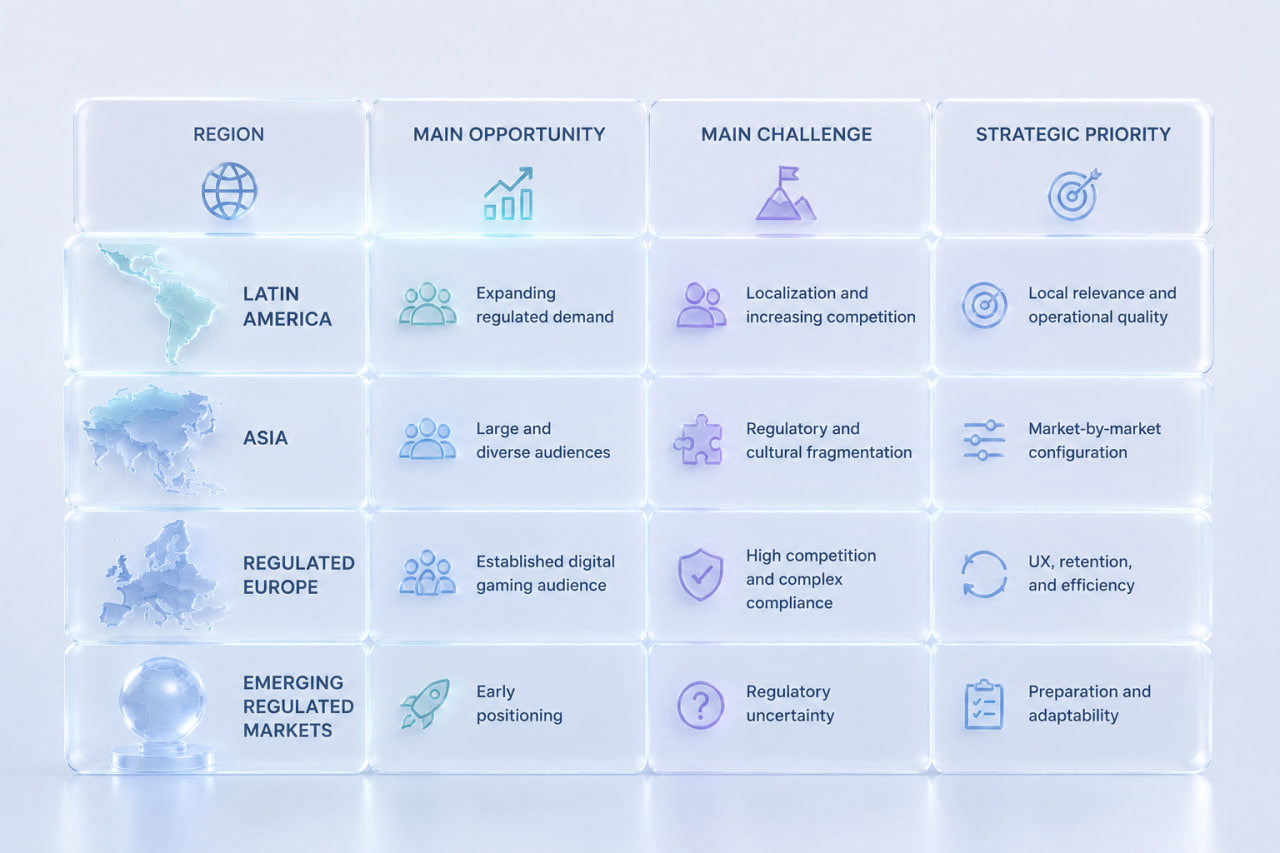
This is why platform flexibility is becoming strategically important. Operators need to be able to modify products without rebuilding their entire technology stack for every jurisdiction.
A flexible poker and casino platform can support different regulatory requirements, currencies, payment systems, languages, tournament schedules, game formats, communication rules, and player-protection measures.
It can also help operators adapt the balance between poker and casino according to the market. In one jurisdiction, poker may act as the primary acquisition product. In another, it may support retention, strengthen the VIP proposition, or provide additional engagement for an established casino audience.
In 2026, adaptability is not simply a technical advantage. It is part of the market-entry strategy.
Localization Is More Than Translation
One of the most common mistakes in regional expansion is treating localization as a final layer added after the main product has already been designed.
True localization influences the entire player experience.
It includes language, but it also includes local payment behaviour, preferred devices, session patterns, customer support expectations, culturally relevant communication, tournament timing, game preferences, and regulatory obligations.
For poker, localization may affect almost every part of the product:
-
the variants and stakes displayed most prominently;
-
the structure and timing of tournaments;
-
the duration of playing sessions;
-
the design of promotional campaigns;
-
the balance between casual and competitive formats;
-
the way players interact through chat, emojis, and other social features.
-
The same promotional mechanic may also generate different levels of engagement across markets. Competitive leaderboards may perform strongly in one region, while missions, short-format tournaments, cash drops, or long-term loyalty progression may be more suitable elsewhere.
Operators should therefore avoid assuming that a successful campaign can simply be copied into another country. Engagement tools should be configurable, measurable, and continuously adjusted using local performance data.
The goal is not to make every regional product completely different. It is to create a consistent core experience that can be adapted where local relevance matters.
Poker as an Anchor Product in the iGaming Ecosystem
Poker can play a broader strategic role than generating direct gaming revenue.
Unlike many individual casino products, poker supports recurring competition, scheduled events, social interaction, player identity, and long-term progression. These qualities can help operators build a community around the wider gaming platform.
A well-integrated poker product may contribute to:
-
longer-term player engagement;
-
stronger loyalty and VIP ecosystems;
-
recurring activity through tournaments and events;
-
social and competitive interaction;
-
increased player advocacy;
-
cross-vertical engagement within the operator’s platform.
-
Poker can also complement casino activity rather than compete with it. Tournament breaks, integrated casino offers, shared wallets, unified promotions, and coordinated loyalty systems can create a more connected player journey across verticals.
For example, casino content can give poker players an additional entertainment option while they wait for a tournament level or another game to begin. At the same time, poker tournaments and community features can give casino players a reason to return at specific times and interact more deeply with the brand.
This does not mean that the same poker strategy will work in every region. Local audiences may prefer different variants, tournament structures, stakes, schedules, and session lengths.
However, when poker is adapted to regional behaviour and connected effectively with the wider casino ecosystem, it can become an anchor product rather than an isolated vertical.
What Should Operators Evaluate Before Entering a Market?
Before committing to a new jurisdiction, operators should assess more than potential audience size.
The evaluation should include:
-
regulatory stability and licensing requirements;
-
local payment availability;
-
identity verification expectations;
-
device and connectivity patterns;
-
preferred casino games and poker formats;
-
expected poker liquidity;
-
market competition;
-
responsible gaming requirements;
-
advertising and promotional restrictions;
-
localization and customer support needs;
-
platform flexibility and integration capacity.
-
These factors should be considered together. A large audience may be less attractive if regulation is unstable or the existing product requires extensive redevelopment. A smaller but clearly regulated market may offer a stronger long-term fit.
Operators should also consider the strategic role each vertical will play. Casino may provide immediate content variety and broad accessibility, while poker may strengthen retention, community, and long-term value. The right balance will depend on local player behaviour and the operator’s wider growth strategy.
Conclusion
Regional expansion in 2026 is becoming less about identifying the largest untapped audience and more about finding the right strategic alignment.
Latin America offers expanding regulated opportunities but increasingly requires deeper localization. Asia provides significant potential but demands market-by-market precision. Europe rewards product quality, retention, and operational efficiency. Newly regulated jurisdictions can create early advantages, but only for companies prepared for continued regulatory change.
Across all these regions, the same principle applies: sustainable growth depends on adaptability.
Mobile-first access is now expected. Localization must extend beyond language. Engagement strategies must reflect regional player behaviour. Poker liquidity must be considered from the earliest stages of market planning. Regulation must be supported by configurable technology rather than treated as an afterthought.
With more than 20 years of experience in online poker and casino technology, Connective Games Malta supports operators in building flexible gaming ecosystems adapted to different regulatory frameworks, regional audiences, and business models.
Our modular platform combines poker and casino capabilities with customizable game formats, tournament tools, engagement mechanics, player segmentation, analytics, and cross-vertical functionality. This gives operators the flexibility to adapt their offering as player expectations and market conditions evolve.
The next major opportunity may not be the biggest market on the map. It will be the market where regulation, player expectations, local relevance, and technology align with the operator’s long-term strategy.
Operators exploring new regional opportunities can contact the Connective Games Malta team to discuss how a flexible poker and casino platform can support their market-entry and growth plans.