
The Hidden Cost of Poor Poker UX
Why the Best Poker Experience Is the One Players Barely Notice
In online poker, user experience is often discussed in terms of convenience, visual design, or product quality. Yet for operators, its impact extends far beyond aesthetics. UX directly influences player acquisition, retention, liquidity, and ultimately revenue.
Unlike many other online gaming products, poker is highly interaction-driven. Players spend extended periods navigating lobbies, joining tables, managing tournaments, multitabling, and making rapid decisions. As a result, even minor friction points can have a disproportionate effect on engagement.
The challenge is that poor UX rarely causes dramatic failures. Instead, it creates a series of small frustrations that gradually erode player satisfaction and reduce long-term activity.
Every Click Matters
Poker players are particularly sensitive to friction because of how frequently they interact with the platform.
A slot player may launch a game and remain in a relatively passive experience for an extended period. A poker player, however, constantly interacts with the software selecting games, switching tables, registering for tournaments, adjusting settings, managing multiple sessions, and responding to gameplay events in real time.
When these actions require unnecessary effort, the friction accumulates. A single extra click may seem insignificant in isolation, but repeated hundreds of times across multiple sessions, it becomes a meaningful source of frustration.
Operators often focus on major features and promotional mechanics, while underestimating the impact of countless micro-interactions that shape the overall player experience.
When Finding a Game Becomes a Challenge
One of the most common UX issues in online poker is lobby overload.
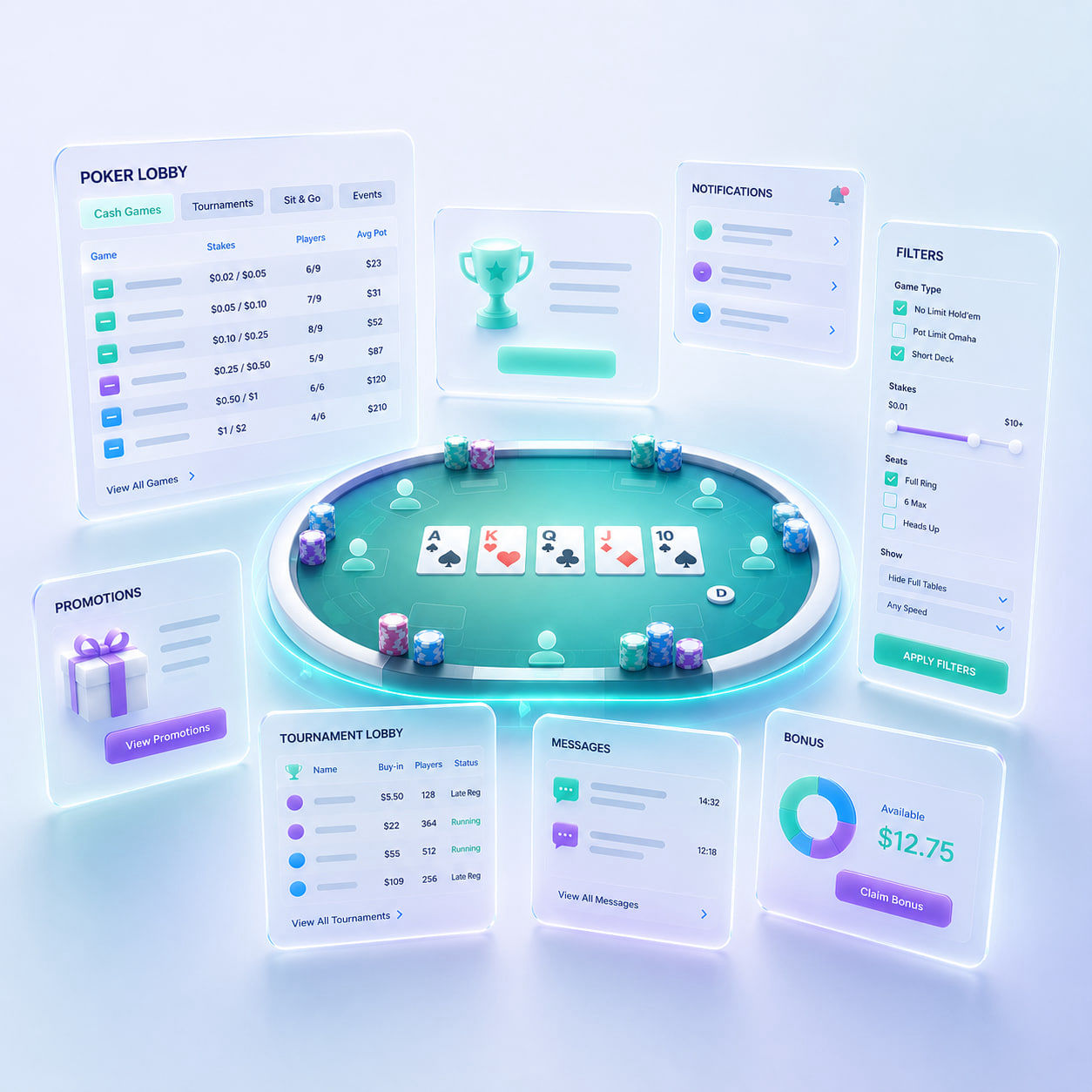
As poker platforms evolve, they often accumulate more game types, tournament formats, filters, promotional events, and informational elements. While offering variety is important, excessive complexity can make it difficult for players to quickly identify the games most relevant to them.
An overloaded lobby creates cognitive friction. Instead of moving directly into gameplay, players are forced to process large amounts of information and navigate increasingly complex interfaces.
This issue is particularly relevant for recreational players, who may have limited familiarity with poker terminology or tournament structures. Faced with too many choices, some players simply leave before joining a game at all.
From an operational perspective, this represents a lost opportunity before gameplay even begins.
The Cost of Breaking Momentum
The period between a player's decision to play and the moment they receive their first hand is one of the most critical stages of the user journey.
Players typically arrive with a clear intention: they want to start playing as quickly as possible. Every additional step between those two moments introduces the risk of abandonment.
Lengthy registration flows, unnecessary confirmations, slow table allocation, excessive loading screens, or complicated navigation can interrupt momentum and reduce engagement.
This principle is well understood in many digital industries. E-commerce companies optimize checkout flows. Streaming services minimize barriers to content consumption. Social platforms focus heavily on reducing friction between intent and action.
Poker operators face a similar challenge. The faster a player can move from intent to gameplay, the more likely they are to remain engaged.
Mobile Is No Longer a Secondary Experience
For years, online poker was primarily a desktop product. Many platform design decisions were built around large screens, mouse interactions, and multi-window workflows.
Player behavior has changed significantly.
Today, many users discover, register, and play entirely on mobile devices. For some audiences, desktop poker is no longer the default experience.
This creates new UX requirements. Interfaces must remain intuitive on smaller screens. Navigation needs to be simplified without sacrificing functionality. Tournament registration, cashier access, table management, and gameplay controls must all be optimized for touch interactions.
A platform that performs well on desktop but feels cumbersome on mobile risks creating an inconsistent player experience across devices.
As mobile adoption continues to grow, mobile usability becomes less of a feature and more of a fundamental requirement.
Perceived Speed Matters as Much as Actual Speed
When discussing platform performance, operators often focus on technical metrics such as latency, infrastructure stability, or server response times.
These factors are certainly important, but player perception is equally critical.
A platform can be technically fast while still feeling slow. Excessive animations, unnecessary transitions, delayed visual feedback, and prolonged waiting states can all create the impression of sluggishness, even when underlying systems perform efficiently.
Players rarely evaluate software through technical benchmarks. They evaluate it through experience. Responsiveness, clarity, and immediacy often have a greater impact on satisfaction than the actual milliseconds involved in a transaction or interface update.
This is why UX design and performance optimization should not be treated as separate disciplines. Together, they shape the player's perception of speed.
Multitabling and the Needs of High-Value Players
Not all players interact with poker software in the same way.
While recreational players may focus on simplicity and accessibility, high-volume players often prioritize efficiency. These users frequently participate in multiple games simultaneously and generate a significant portion of overall activity and liquidity.
For them, interface design has a direct impact on productivity.
Poor table management, inadequate notifications, cluttered layouts, limited customization options, or inefficient navigation can quickly become major pain points.
The challenge is that these players are often among the most experienced users on the platform. They are highly aware of alternative products and are more likely to compare software quality across operators.
As a result, weaknesses in multitabling functionality can disproportionately affect some of the platform's most valuable users.
The Hidden Impact on Retention
Many operators associate retention primarily with promotions, loyalty programs, tournaments, or reward mechanics.
These tools certainly play an important role, but they cannot fully compensate for a frustrating user experience.
Players may initially join because of a welcome offer, a tournament series, or an attractive promotion. Their decision to return, however, is often influenced by something much simpler: whether the experience felt effortless.
Poor UX rarely appears in player feedback reports as a primary complaint. Instead, it manifests through lower session frequency, shorter play sessions, reduced engagement, and gradual churn.
This makes UX particularly challenging to evaluate. Its impact is often indirect, cumulative, and difficult to isolate from other business metrics.
Yet over time, these seemingly small friction points can have a measurable effect on player retention and platform performance.
Questions Every Operator Should Ask About Their Poker UX
While every platform serves different audiences and business goals, there are several areas worth reviewing on a regular basis:
Can players find a game within seconds?
The lobby should help players make decisions, not overwhelm them with options. If users need excessive filtering or navigation before joining a table, the discovery experience may need refinement.
How many steps separate intent from gameplay?
From registration to seating, every additional action creates an opportunity for abandonment. Reviewing the path from landing on the platform to receiving the first hand can often reveal unnecessary friction.
Does the platform feel equally intuitive on mobile?
Many players now interact primarily through mobile devices. Features that work well on desktop may require a completely different approach on smaller screens.
Does the software feel fast, not just perform fast?
Technical performance matters, but so does perception. Long animations, delayed feedback, and unnecessary transitions can make an otherwise stable platform feel sluggish.
Can high-volume players multitask efficiently?
Experienced players often interact with the software differently than recreational users. Table management, alerts, navigation, and customization options should support efficient multitabling without creating visual clutter.
Are UX decisions driven by player behavior?
Analytics can reveal where players abandon onboarding flows, leave lobbies, switch devices, or reduce session length. These signals often highlight UX issues long before they appear in player feedback.
When was the last time someone audited the player journey?
Poker products evolve continuously. New features, promotions, game formats, and interface updates are added over time. Periodic reviews help ensure that complexity does not gradually replace usability.
Conclusion
In online poker, user experience is not merely a design consideration. It is a business factor that influences every stage of the player journey.
An overloaded lobby, unnecessary onboarding friction, slow seating processes, weak mobile usability, excessive animations, or inefficient multitabling tools may appear minor when viewed individually. Collectively, however, they shape how players perceive the platform and whether they choose to return.
For operators, the most significant UX challenges are often not the ones that generate support tickets or immediate complaints. They are the small points of friction that quietly reduce engagement over time.
As competition in online poker continues to evolve, delivering a smooth, efficient, and intuitive experience is no longer simply a matter of product quality. It is increasingly becoming a key factor in long-term player retention and operational success.
Get In Touch
To learn more about Connective Games’s poker offering, contact us at [email protected].